


Treatment of toenail fungus with folk remedies should begin at an early stage of damage to the nail plates.The sooner steps are taken to get rid of the disease, the more effective the treatment will be.In advanced cases, the use of pharmaceutical drugs is recommended.Traditional medicine can only complement the treatment.
To get rid of fungus, medicinal plants, soda, boric acid, hydrogen peroxide and other means are used.Tinctures of medicinal herbs and essential oils are no less effective.
Identification of the fungus
Nail fungus or onychomycosis always starts with an infection of the nail plate of the big toe.Yellow spots and streaks appear first.The disease develops slowly, so this stage can persist for a very long time, up to several months.Then the nail plate begins to change - it thickens and deforms.From the big toe, the fungus gradually spreads to other nails.A severe form of the disease is manifested by severe deformation of the nail plates, changes in the color and structure of the nails, shedding and a strong unpleasant odor.
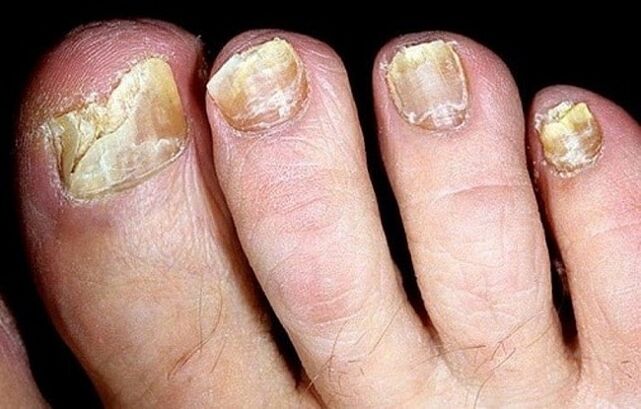
The fungus also spreads in the spaces between the fingers.This manifests as redness and peeling of the skin between the toes.Due to a decrease in local immunity, there is a risk of secondary infection.In this case, a rash appears in the affected area, itching and swelling of the skin appear.
Fungus on the hands is quite rare.In this case, self-infection can occur if a person, when treating toenails affected by fungi, does not observe the rules of hygiene.Pathogenic microflora penetrates under the nail plates on the hands and may not be felt for a long time.The process of destroying the nails takes longer than with a foot disease.Constant contact with water and intense sweating of the palms can accelerate the growth of pathogenic microflora.The ideal environment for the growth of the fungus is moist skin, while the pathogen grows faster in a warm environment.
Wearing socks, tight shoes and poor foot hygiene contribute to the development of foot disease.Hands are usually not restricted by gloves and come into contact more often with household chemicals and soap, which slows down the spread of the fungus.
Rules of treatment
It is necessary to completely treat nail fungus at home.In addition to using homemade solutions and ointments, foot baths are essential.They work both as an auxiliary and as a primary healing agent, help to steam and soften the nail plates, provide antiseptic treatment and skin hygiene.
A foot bath prepares the nails for the application of the treatment product.After steaming your feet, be sure to remove the overgrown areas.In case of severe damage, when the deformation of the upper layer of the nail plate begins, you need to use a nail file.
It is important to use disposable manicure tools.Fungal spores land on the surface of scissors and files, so reusing them without disinfection can lead to infection of healthy nails.
The steamed nail plate must be carefully processed not only along the edge, but also along the top.This will help remove the softened areas and allow better penetration of the drug.
Patients often complain that the treatment for fungus on the big toe does not bring results.This is due to a violation of the rules of personal hygiene.Fungal spores remain on clothing, socks, towels, bathroom surfaces - that is, on anything that comes into contact with the affected area.Pathogenic microflora is very resistant to household chemicals.If treated incorrectly or insufficiently, the fungus remains viable for several months.After a course of treatment, a person can become infected again through contact with clothing or shoes that have spores on them.
During treatment, it is recommended to have two sets of clothes, shoes, towels, socks and bed linen available.Every day it is necessary to carry out a comprehensive antiseptic treatment of the things with which the patient came into contact during the day.It is recommended to boil socks, towels and bedding and then iron or steam them with an iron.For the treatment of shoes, it is better to use special sprays and antiseptic solutions.
Thus, effective treatment is possible only if a person has learned several rules:
- a nail bath is not a whim, but a necessary preparatory and therapeutic process.
- For successful treatment, disposable manicure tools are used.
- Shoes and clothes are disinfected daily.
Treating nail fungus is a long process.You need to be patient, because you will not be able to completely overcome the infection in one go.You must use home remedies in a lesson.
Foot baths
Various products with antiseptic properties are used for the preparation of baths.This procedure has two goals at the same time - to steam your feet, prepare them for the application of medicinal products and prevent the spread of fungal flora on healthy nails.You can use any recipe as long as you do it regularly:
- Fill a basin with 4 liters of hot water, pour 50 ml of celandine oil into the water.
- Dissolve three tablespoons of laundry soap shavings in a glass of water.Add two tablespoons of baking soda, stir until completely dissolved.Pour the resulting solution into a bowl of warm water.
- The simplest recipe: add half a glass of salt and soda to a bowl of hot water.The product perfectly fights fungal infections, but it has a significant drawback - it dries the skin of the feet.After bathing, it is recommended to apply any oily cream to your feet.
- Add a tablespoon of baking soda and salt to a bowl of water, squeeze the juice of half a lemon.You can use lemon essential oil (7-10 drops).
- Add 20 ml of iodine solution to the water.
- Propolis alcohol tincture effectively fights fungi.On average, take one tablespoon of tincture for every liter of hot water.
- Calamus root has an antiseptic and fungicidal effect.You need to boil two tablespoons of the root, crushed with a knife, in a glass of water for 20 minutes and then leave for three hours.The broth is filtered and added to a bowl of hot water.
- You can use pine needles or felantina grass.In the first case, two glasses of needles are required for a basin of water.Celandine is used dried.Add 4 tablespoons of raw materials to 4-5 liters of water.
- Another effective recipe: 5 tablespoons of laundry soap shavings and one spoon of iodine.
- Boric acid is widely used for treatment.It is necessary to add a solution of boric acid to the foot bath at a ratio of one tablespoon of the product for every liter of water.
Foot baths should be done daily for 15 - 20 minutes.It is best to do the procedure before going to bed.Bathing is a preparatory step before the application of strong agents, but it can be used to prevent fungal infection after visiting public places with high humidity.
Soda and salt
You can remove the fungus from an adult using simple and inexpensive means.Salt is used as an antiseptic and soda has an antifungal effect.This method cannot be used to treat the fungus in children, as these substances dry the skin too much.Babies may experience irritation.
The fastest way to get rid of fungus is with a baking soda paste.To prepare it, combine it with water in equal proportions.The product is applied to each nail for 10 minutes.For convenience, you can use cling film.After the procedure, your feet should be washed with soap-free water.
You can treat your nails with the following solution.Mix a teaspoon of soda, salt and iodine, add 2 tablespoons of water.Soak a cotton swab in the resulting product and apply to each affected nail for 5 minutes.
A great time-tested remedy for fungus is baking soda and vinegar.To prepare the medicine you will need other ingredients.It is necessary to rub a quarter of the laundry soap and dissolve the shavings in 100 ml of hot water.Then add 2 tablespoons to soapy water.soda and 1 tsp.vinegar.Mix everything well and apply to the nails with a cotton swab.It is recommended to additionally wrap the compress with film.This application should be maintained for 15 minutes.
Treatment with boric acid
Boric acid is a powerful antiseptic that helps remove nail fungus.It can be used in several ways:
- Boric acid ointment is applied to each affected nail twice a day, morning and evening.Before that, you need to steam your feet.
- Boric acid powder is added to the foot bath, which is done every three days at night.Proportions - 20 g of powder per 4 liters of water.
- Applications with boric acid solution are carried out overnight.To do this, you need to dilute it with water (1:1) and apply the product using a cotton swab or nail polish brush.
Treatment with boric acid is carried out for two weeks.Long-term use of boric acid causes side effects - nausea, headache, reduced blood pressure.The product is not used to treat children and pregnant women.
Hydrogen peroxide
You can treat nail plates with regular hydrogen peroxide.The product can be applied in its pure form.To do this, soak a cotton swab in the solution and process the nail plates.The fight against the fungus with peroxide is carried out for two weeks.In the first of them it is better to apply a clear solution, in the second - mix it with water.This method of application will help to avoid the development of side effects that occur with long-term treatment.
Peroxide can be added to foot baths.Proportions - one tablespoon for every liter of water.
Homemade ointment
All the mentioned antifungal drugs have one major drawback - they dry the skin a lot.This causes discomfort, peeling and irritation of the perilingual ridges.A simple homemade ointment will help solve the problem.To prepare it you will need:
- sea buckthorn oil;
- table vinegar;
- an egg.
You need to mix one tablespoon of oil and vinegar with one egg.You can use only the yolk - this will make the ointment more nutritious.This mixture is applied daily before going to bed.The course of treatment lasts about three weeks.It is necessary to apply the product until the symptoms disappear completely.The homemade ointment perfectly softens the skin, the vinegar destroys the fungi and the sea buckthorn oil stimulates the restoration of the affected nail plates.
Tinctures and oils
You can lubricate the nail plates with propolis alcohol tincture.This drug has an antiseptic effect and increases local immunity.For effective treatment, the treatment should be carried out three times a day.The dye is applied with a cotton swab or a nail polish brush.It will be convenient to use the product by first pouring it into an empty nail polish bottle.No need to rinse the product.
You can buy celandine oil at the pharmacy.This drug is poisonous, but works well against fungi.If you use the oil correctly, there will be no side effects and not a trace of fungus will remain in just 10-14 days.The oil is applied with a pipette.Before applying the product, it is necessary to steam your feet and remove the affected layer of the nail plate.Celandine oil should be used at night.
Tea tree oil is a powerful natural antiseptic.The product has a fungicidal effect.The oil should be applied to your nails before going to bed.No need to rinse.
Another effective remedy is the use of lemon oil.The product can be added to baths, made into compresses or applied in its pure form.To prepare a bath, use 10 drops of oil per 4 liters of water.You can add 5 drops of oil to 50 ml of water, soak a gauze pad in the solution and apply to your nails for 15 minutes.In its pure form, apply with caution.A single drop is enough to treat your nails.The product is applied with a pipette or brush, left for 20 minutes and then washed off with water.
Treatment of fungal nail plates should be carried out daily.On average, the course lasts about three weeks.It is recommended to continue treatment for a week after symptoms disappear.To avoid re-infection, apply baths and compresses 2 times a week.